How Do You Know if Something Has a Vertical or Horizontal Asymptote
Asymptotes: Examples
So far, we've dealt with each type of asymptote separately, kind of like your textbook probably does, giving 1 section in the affiliate to each type. Only on the examination, the questions won't specify which type y'all need to notice.
In full general, y'all will be given a rational (partial) function, and y'all volition demand to find the domain and whatever asymptotes. Y'all'll need to discover the vertical asymptotes, if any, then figure out whether you've got a horizontal or slant asymptote, and what it is. To make sure yous arrive at the correct (and consummate) answer, you volition need to know what steps to have and how to recognize the different types of asymptotes.
Let's become some do:
-
Observe the domain and all asymptotes of the following function:
I'll kickoff with the vertical asymptotes.
They (and any restrictions on the domain) will be generated by the zeroes of the denominator, so I'll set the denominator equal to zip and solve.
Then the domain is all x -values other than , and the two vertical asymptotes are at .
Next I'll plough to the result of horizontal or slant asymptotes.
Since the degrees of the numerator and the denominator are the same (each beingness 2), then this rational has a not-nada (that is, a non- ten -centrality) horizontal asymptote, and does not have a slant asymptote. The horizontal asymptote is found past dividing the leading terms:
And so the full answer is:
domain:
vertical asymptotes:
horizontal asymptote:
camber asymptote: none
A given rational part may or may not have a vertical asymptote (depending upon whether the denominator e'er equals zero), but (at this level of study) it will always have either a horizontal or else a slant asymptote.
Annotation, however, that the role will only accept i of these two; you volition have either a horizontal asymptote or else a slant asymptote, but non both. As presently as y'all see that you lot have one of them, don't bother looking for the other one.
-
Discover the domain and all asymptotes of the following function:
The vertical asymptotes come from the zeroes of the denominator, and then I'll prepare the denominator equal to zero and solve.
Oops! This has no solution. (Duh! The denominator is a sum of squares, non a deviation. So of grade information technology doesn't factor and it tin can't accept real zeroes. I should remember to await out for this, and save myself some fourth dimension in the future.)
Since the denominator has no zeroes, then there are no vertical asymptotes and the domain is "all x ".
Since the caste is greater in the denominator than in the numerator, the y -values will be dragged downwardly to the x -axis and the horizontal asymptote is therefore " y = 0". Since I have found a horizontal asymptote, I don't accept to await for a slant asymptote.
My full answer is:
domain: all x
vertical asymptotes: none
horizontal asymptote: y = 0 (the 10 -centrality)
slant asymptote: none
The Special Case with the "Pigsty"
Nosotros've dealt with various sorts of rational functions. When y'all were first introduced to rational expressions, you probable learned how to simplify them. You'd factor the polynomials top and bottom, if you could, and then you'd see if anything cancelled off.
What if yous've found the zeroes of the denominator of a rational part (so you've found the spots disallowed in the domain), only one or another of the factors cancels off? Let's look at an case of exactly that situation:
-
Find the domain and all asymptotes of the post-obit part:
It so happens that this role can be simplified as:
So the unabridged rational function simplifies to a linear function. Clearly, the original rational function is at to the lowest degree nearly equal to y = x + 1 — though I need to go along in heed that, in the original function, x couldn't accept on the value of 2. Simply what about the vertical asymptote? Is there one at ten = 2, or isn't in that location?
If there is a vertical asymptote, and then the graph must climb up or down it when I use x -values close to the restricted value of x = two. I'll try a few x -values to run across if that's what's going on.
ten = one.5, y = 2.v
ten = one.9, y = ii.9
x = ane.95, y = 2.95
x = 1.99, y = 2.99
Not merely is this not shooting off anywhere, information technology'southward actually interim exactly like the line y = 10 + 1. Then patently the nil of the original denominator does non generate a vertical asymptote if that zero's gene cancels off.
While the graph of the original function volition look very much like the graph of y = x + 1, it volition not quite be the same. And, whether or non I'm graphing, I'll need to remember about the restricted domain.
Since the degree of the numerator is ane greater than the caste of the denominator, I'll take a slant asymptote (not a horizontal 1), and I'll find that slant asymptote by long division.
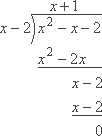
Hmm... There wasn't any remainder when I divided. Actually, that makes sense: since ten − 2 is a gene of the numerator and I'm dividing by x − 2, the segmentation should come out evenly. And, as I'd kind-of expected, the slant asymptote is the line y = x + i.
And so the full answer is:
domain: x ≠ 2
vertical asymptotes: none
horizontal asymptote: none
slant asymptote: y = x + 1
This concluding case ("with the hole") is not the norm for slant asymptotes, but yous should expect to come across at least 1 problem of this type, including perhaps on the test.
By the fashion, when yous go to graph the part in this final example, you tin depict the line right on the slant asymptote. But you volition need to leave a nice open dot (that is, "the hole") where 10 = 2, to bespeak that this betoken is not actually included in the graph considering it'southward not part of the domain of the original rational part.
To summarize, the procedure for working through asymptote exercises is the following:
- set the denominator equal to zero and solve (if possible)
- the zeroes (if any) are the vertical asymptotes (assuming no cancellations)
- everything else is in the domain
- compare the degrees of the numerator and the denominator
- if the degrees are the same, and so y'all take a horizontal asymptote at y = (numerator's leading coefficient) / (denominator's leading coefficient)
- if the denominator's degree is greater (by whatever margin), then you have a horizontal asymptote at y = 0 (the x -axis)
- if the numerator's degree is greater (by a margin of 1), then you lot have a slant asymptote which you volition find by doing long division
The but hard role is remembering that sometimes a cistron from the denominator might abolish off, thereby removing a vertical asymptote just non changing the restrictions on the domain. Yous might even want to make it the habit of checking if the polynomials in the numerator and denominator factor, just in example.
Either way, when you're working these problems, try to go through the steps in lodge, so you lot can remember the whole process on the examination. These exercises are not so hard in one case y'all get the hang of them, so be certain to do plenty of practice exercises.
How Do You Know if Something Has a Vertical or Horizontal Asymptote
Source: https://www.purplemath.com/modules/asymtote4.htm
0 Response to "How Do You Know if Something Has a Vertical or Horizontal Asymptote"
Post a Comment